Gurukshetra Consultancy | Strategic Communication Advisory
The Miracle Metal - ZINC
I started exploring the usages of Zinc from scratch, and with every single finding, my trust on the metal has only been increasing. My curiosity has led me to search for Zinc in everything we use or consume in our daily lives.
For once, I have been continuously exploring properties and usages of Zinc, and not because I have worked for Hindustan Zinc, but to know why this metal is the 4th most sought after metal in the world and how it became the 8th known metal to mankind.
Germans called Zinc metal as ‘Caunterfeitum’ or ‘Mock-Silver’ because of its silvery white lustre and ‘rishis’ of Vedic era recommend ‘Jasada Bhasma’ a Zinc based preparation, as the treatment of choice for diabetes.
The importance of Zinc has been known to India since ancient times. Modern medicine also recognizes the curative properties of Zinc. Long before being identified as an element, Zinc was used for making brass and for medicinal purposes. Metallic Zinc and Zinc Oxide were produced in India sometime between the 11th and 14th centuries and in China in the 17th century. Andreas Marggraf, a German chemist is credited with the discovery of pure metallic Zinc who isolated the element in 1746.
While Zinc was unknown in Europe until the end of 16th century, India had been producing Zinc at a large scale since the 12th century onwards. The mines in Rajasthan have given evidence of Zinc production since 6th century BC. Zinc was distinctly recognized as a metal under the designation of ‘Yasada’ or ‘Jasada’ (Yashad) in the medical dictionary written in the year 1374. Alchemists burned Zinc in air to form Zinc Oxide, also called, ‘philosopher’s wool’ or ‘white snow’. Charaka Samhita, which was written between 300 AD and 500 AD, mentions a metal which, when oxidized, produces ‘Pushpanjan’, which was thought to be Zinc Oxide. Smelting and extraction of impure Zinc by reducing calamine with wool and other organic substances was accomplished in the 13th century in India. The Chinese did not learn of the technique until the 17th century.
The Zawar mines of Rajasthan are one of the oldest evidence of Zinc mines that date back to the 9th century. These mines have been active since the Mauryan period. The smelting of metallic Zinc appears to have begun around the 12th century in India.
Today, Zinc is the 4th most widely consumed metal in the world after iron, aluminium, and copper. According to ILZSG, 50 per cent of the Zinc mined across the world is used for galvanizing, 17 per cent for Zinc alloying, 17 per cent for brass and bronze making, 6 per cent for Zinc semi-manufacturers, 6 per cent in chemicals, and 4 per cent for other miscellaneous purposes.
An adult human body contains about 2-3 grams of Zinc, needed for the body’s enzymes and immune system to function properly. Every cell requires Zinc to multiply. Zinc strengthens the immune system to prevent and effectively fight diarrheal diseases which are often life threatening for children in developing countries. A few extra milligrams of Zinc everyday could save the life of 450,000 kids (Source: UNICEF).
Zinc also helps in improving eyesight, preventing respiratory infections, treating acne, common cold, age-related chronic diseases, improving fertility and has healing properties. Also, extensive usage in insect repellents, sun screens, paints, rubber, cosmetics, surgical tools, airplanes, appliances, pharmaceuticals, plastics, inks, soaps, batteries, textiles, electrical equipment etc. makes Zinc a future metal which is extensively used to cure human and infrastructural health.
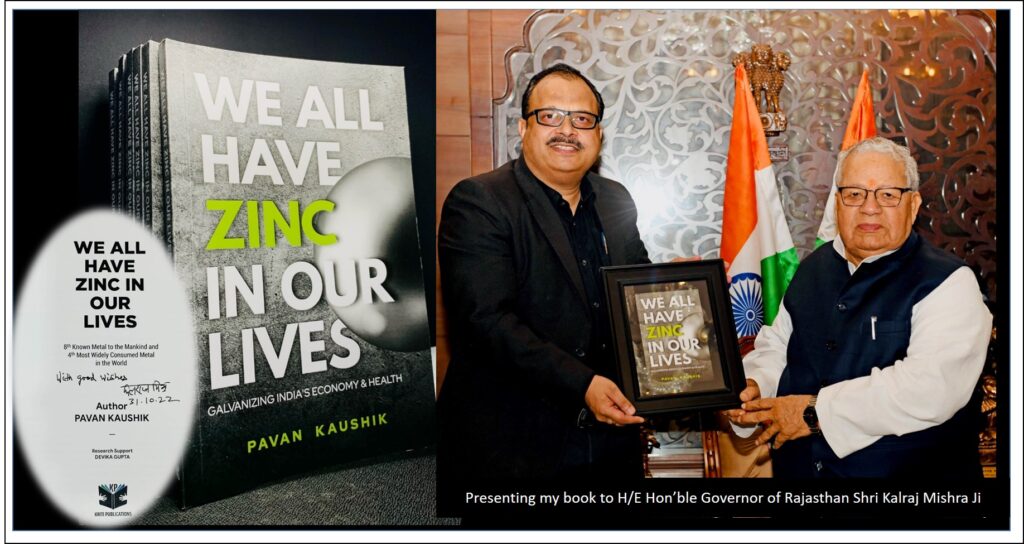
This book comprises extracts and outcomes of research studied from across the globe which focuses on how Zinc has played a crucial role towards strengthening of infrastructure and how consumption of Zinc acts as a boon to not just physical but also mental health. However, it is to be noted that in case of supplements, it is advisable to consult with a physician.
This book will give you an insight on usages of Zinc in many forms and properties. The book – ‘We all have Zinc in our lives’.
I can only tell you with complete confidence now that ‘We all have Zinc in our lives’.
The book is available on AMAZON