Gurukshetra Consultancy | Strategic Communication Advisory

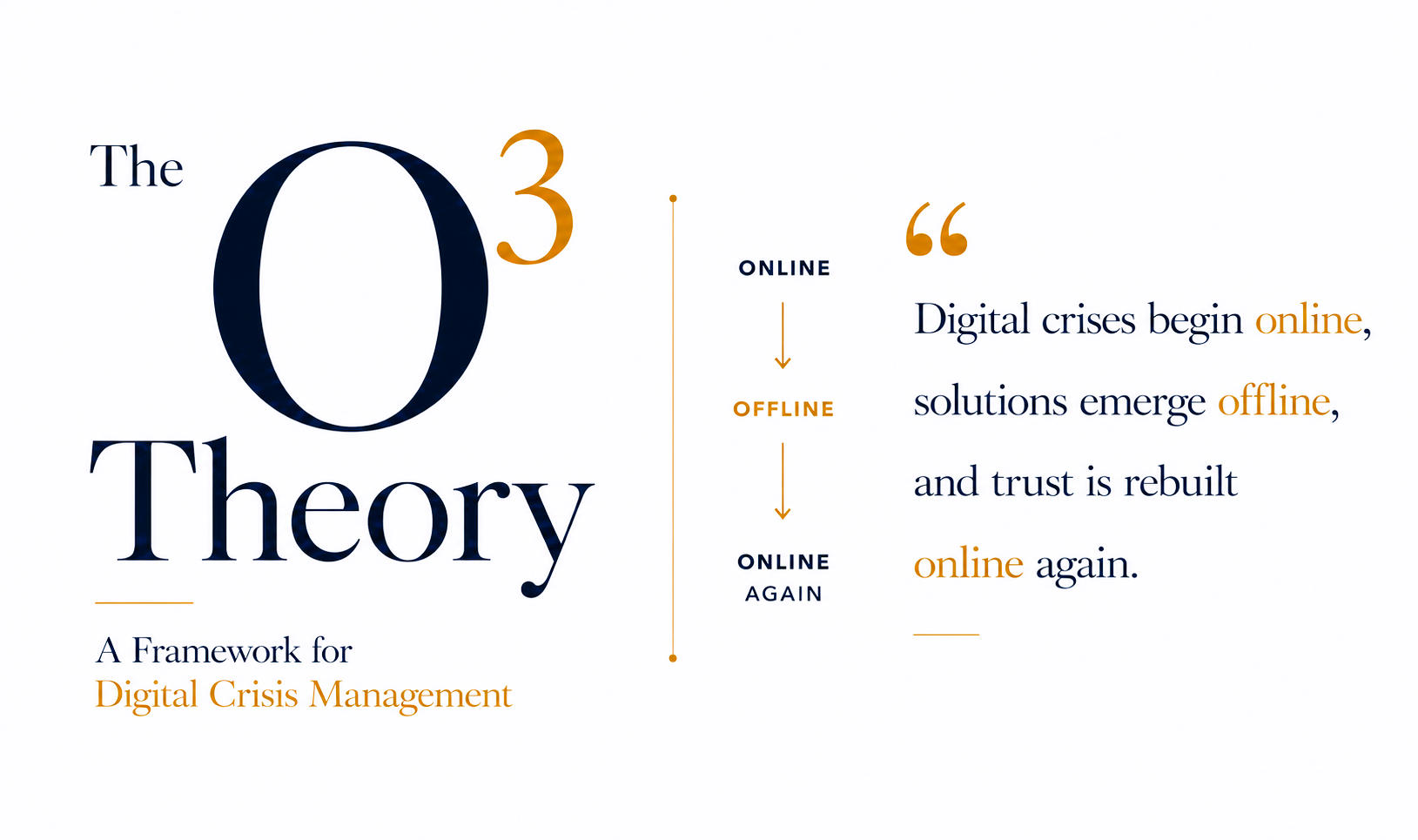
The O3 Theory: A Framework for Digital Crisis Management
“Digital crises begin online, solutions emerge offline, and trust is rebuilt online again.”
Social media has fundamentally altered how crises emerge, escalate and influence reputation.
What once unfolded over hours—or even days—can now escalate within minutes. A single post can attract widespread attention, shape public perception and place organisations under immediate scrutiny. More importantly, crises no longer develop behind closed doors. They unfold publicly, in real time, often before organisations have fully understood the situation themselves.
In such an environment, the first response is no longer internal deliberation.
It is external acknowledgement.
Through years of advising organisations across mining, metals, infrastructure, manufacturing and other stakeholder-sensitive sectors, I observed a recurring pattern. Organisations often made one of three mistakes. Some remained silent during the early stages of a digital crisis. Others attempted to resolve complex issues publicly through social media exchanges. Many successfully resolved issues but failed to communicate that corrective action had been taken.
Each approach weakened trust.
These observations led to the development of the O3 Theory—a structured framework for managing digital-era crises and stakeholder engagement.
The framework is built around a simple but disciplined three-step process:
Respond Online.
Resolve Offline.
Reassure Online Again.
Stage One: Respond Online
When a concern emerges on social media, it must first be acknowledged on the same platform.
Silence is rarely neutral.
More often, it is interpreted as indifference.
Even when complete information is unavailable, a timely response demonstrates awareness, accountability and intent to engage. Stakeholders may not expect immediate solutions, but they do expect organisations to acknowledge concerns and demonstrate responsibility.
The objective of the first stage is not resolution.
It is acknowledgement.
A simple response such as:
“We are aware of the matter and are examining it.”
often accomplishes something important.
It reassures stakeholders that the organisation is listening.
Stage Two: Resolve Offline
While crises often begin online, meaningful resolution rarely occurs there.
Social media is designed for visibility, not for resolution.
Complex issues require context, dialogue, investigation and engagement. They often require conversations that cannot be conducted effectively through public comment threads.
The second stage therefore moves the issue offline through direct interaction, whether by phone, email, video conference, stakeholder engagement or face-to-face discussion.
The objective is not to win an online argument.
The objective is to solve the problem.
Real solutions are built through understanding, not through public exchanges.
Stage Three: Reassure Online Again
Many organisations successfully resolve issues but fail to communicate that resolution publicly.
As a result, the complaint remains visible while the solution remains invisible.
The final stage of the O3 Theory requires organisations to return to the same platform where the issue originated and communicate closure responsibly.
This is not about publicity.
It is about accountability.
Stakeholders deserve to know that concerns were addressed, corrective actions were taken and lessons were learned.
This final step helps restore confidence, strengthen credibility and rebuild trust.
A Practical Illustration
Consider a customer complaint that gains traction on social media.
If the organisation remains silent, the narrative expands.
If it argues publicly, the issue escalates.
If it resolves the matter privately but never communicates closure, stakeholders continue to believe the issue remains unresolved.
The O3 Theory addresses each of these risks through a structured sequence of acknowledgement, engagement and reassurance.
The issue is acknowledged online.
The solution is developed offline.
The outcome is communicated online again.
The loop is completed.
Why the O3 Theory Matters
At its core, the O3 Theory is not complex.
Its strength lies in discipline.
Many organisations respond to crises with urgency but without structure. The result is often delayed responses, fragmented communication and loss of narrative control.
The O3 framework provides consistency, clarity and speed—three elements that increasingly define effective communication in high-pressure situations.
Crisis management today is no longer limited to resolving issues.
It is equally about managing perception in real time.
Every response influences the narrative.
Every narrative influence trust.
And trust ultimately influences reputation.
The O3 Theory demonstrates how Corporate Communication has evolved beyond information management. It reflects the growing responsibility of the Fifth Estate to protect trust, preserve credibility and restore stakeholder confidence in an environment where perception often travels faster than facts.
As digital ecosystems continue to accelerate the flow of information, organisations must adapt not only their communication capabilities but also their communication mindset.
Because in the digital age, how an organisation responds is often just as important as what it resolves.
The O3 Theory reflects a simple reality of modern communication:
Respond Online.
Resolve Offline.
Reassure Online Again.