
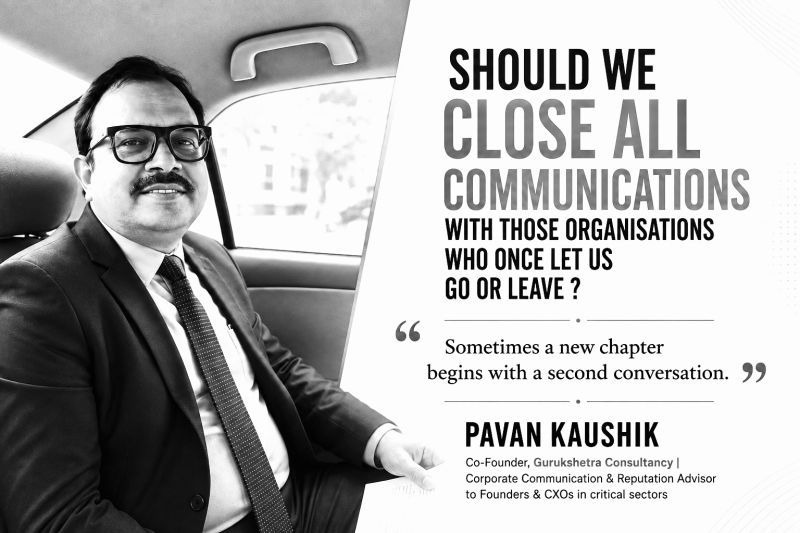
A close friend of mine was asked to leave, and the management realised in just two months that it was the wrong decision. The HR team ane d the Head of the Department called my friend and asked him to rejoin, as ‘they’ would like to consider working together again.
Meanwhile, my friend had already joined an organisation and was quite happy.
His reply to HR and his Department Head was quite thought-provoking.
He wrote: “I am amazed at your call asking me to rejoin. I am not able to understand how come suddenly you have found value in me, that you were unable to find in the last 10 years of loyalty, and if you could enlighten me.
On the day of my resignation I lost all my respect for the number of years I spent in the organization – I lost my hope. On the day, I did not just resign from my position; I also resigned from the people and the organisation.
Please find a better person for the job – as for me, I worked for the organisation.”
This response made me think:
Should we close all communication with those organisations that once let us go or asked us to leave?
Should I accept an offer to rejoin an organisation that I once left – or one that asked me to leave because of right-sizing, performance concerns (biased), restructuring, or for any other reason?
And the answer was never simply YES or NO.
Q.1 What has changed in such a short period?
Q.2 Why do they suddenly want me back?
Q.3 Are they realising their mistake and trying to correct it?
Q.4 Has the leadership/HR changed?
Q.5 Were they unable to find a replacement as proficient as me?
I have always said: 𝐃𝐨𝐧’𝐭 𝐭𝐨𝐮𝐜𝐡 𝐦𝐲 𝐬𝐞𝐥𝐟-𝐫𝐞𝐬𝐩𝐞𝐜𝐭. 𝐌𝐲 𝐞𝐠𝐨 𝐰𝐚𝐤𝐞𝐬 𝐮𝐩, 𝐚𝐧𝐝 𝐲𝐨𝐮 𝐜𝐚𝐧’𝐭𝐡𝐚𝐧𝐝𝐥𝐞 𝐭𝐡𝐚𝐭.
Sometimes, an organisation understands your value only after you leave. But going back should not mean returning to the same circumstances that made you leave in the first place.
The real question still remains: “Should I go back?”
What would have been your call in such circumstances?